

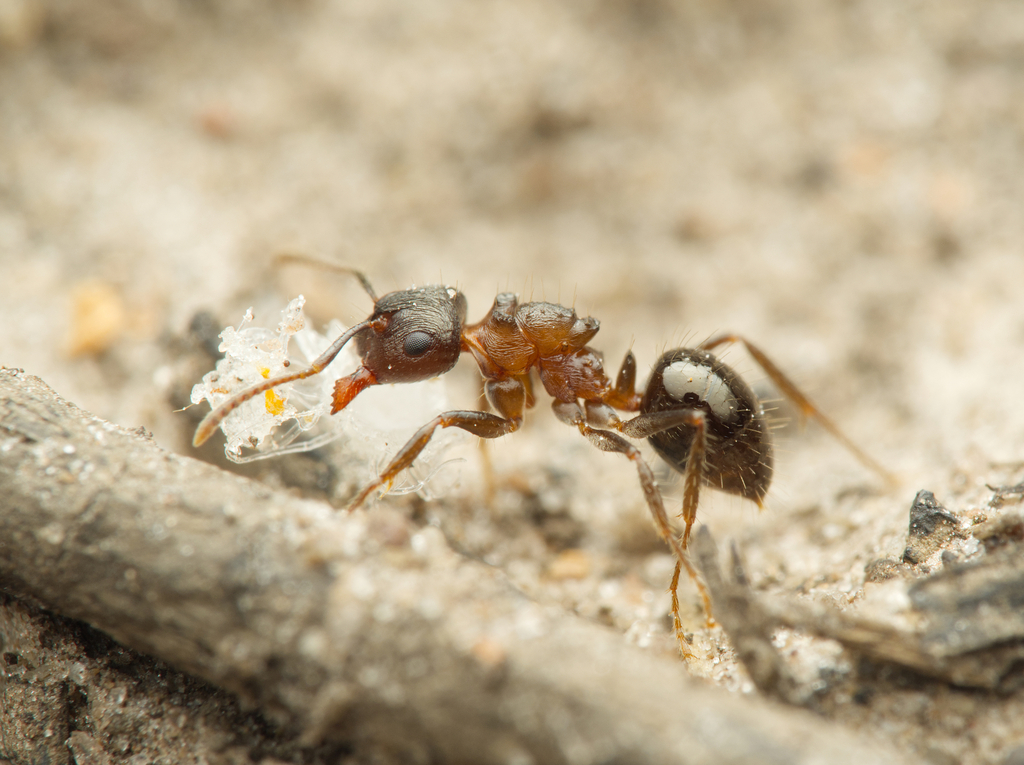
Description
Notoncus, often called epaulet ants, are native ground-nesting ants from New South Wales and the ACT, and they are common in Canberra gardens and bushland. They are small, easy to overlook and rarely offered for sale, which makes them a good choice for someone who wants something different from a sugar ant. The two species most often recorded in the ACT are Notoncus capitatus and Notoncus ectatommoides. They look very alike, so we list this ant as Notoncus sp. rather than promise a species.
- Species: Notoncus sp. (most likely N. capitatus or N. ectatommoides)
- Common name: Epaulet ant
- Difficulty: Intermediate
- Diet: Sugars (honey or sugar water) plus small insects
- Size: Small to medium workers, about 5 mm
- Temperament: Small ground-foragers; no sting
- Colony growth: Little published data; expect slow to moderate growth
- Housing: Test tube, then a small nest with an outworld that has a snug lid
Key points
- Founding: Keepers disagree. One hobby report calls the queens “somewhat semi-claustral” and another calls the genus fully claustral, so offer a founding queen a drop of honey and watch how she responds. The colonies we supply are already past this stage.
- Polymorphism: Workers vary only slightly in size, with no distinct majors and minors (AntWiki, genus page).
- Diet: In the wild they are general predators that forage on the ground, and they have been photographed tending scale insects for honeydew at the Australian National Botanic Gardens (NatureMapr). In captivity, offer honey or sugar water plus small amounts of protein such as fruit flies.
- Habitat: Soil and ground nests, often under stones and logs, in forest, gardens and parks. They are active all year, and in some areas more active in winter.
- Temperature: We have not found a published care sheet for Notoncus. As a local ground-nester that stays active through winter, it is comfortable at normal room temperature and needs no heating. Avoid the sunny windowsill.
- Humidity: No species-specific figures are available. Use a gradient: a lightly damp end of the nest and a drier outworld, so the ants can choose.
- Feeding: Small amounts, little and often. One keeper reports that founding queens were reluctant to take a second drop of honey, so vary what you offer.
- Escape risk: Moderate. Use a snug lid and a barrier, and keep openings small.
- Sting or bite: Notoncus are formicine ants, which do not sting. They may nip or spray a little formic acid if disturbed.
- Interesting observation: The two common ACT species are superficially very similar, and some Canberra sightings on NatureMapr can only be recorded as Notoncus sp. because the photos are not clear enough to separate them.
What you get
A queen with a small number of workers and brood: a small colony, typically around 5 workers. Numbers and the amount of brood vary with the season and what we have available. Because published husbandry notes for this genus are thin, we will share what we learn with you.
Shipping and the law
We ship within Australia only. We do not send this species to Western Australia or Tasmania without the relevant clearance. Western Australia prohibits entry of organisms that are not on its permitted list, so we do not send to WA unless Quarantine WA has confirmed in writing that the species is allowed. Tasmania allows only three ants to be imported without restriction (Camponotus consobrinus, Camponotus claripes and Colobopsis macrocephala), so a Tasmanian import permit would be needed for Notoncus. Please check your own state or territory’s rules before you order. Our guide has the details: Is it legal to keep ants in Australia?
Care guides
- Test tube setup for a founding ant queen
- What to feed pet ants in Australia
- Best formicarium for beginners
Photo credits: Notoncus ectatommoides by Nigel Main, CC BY 4.0, via iNaturalist.
Reviews
There are no reviews yet.