

Description
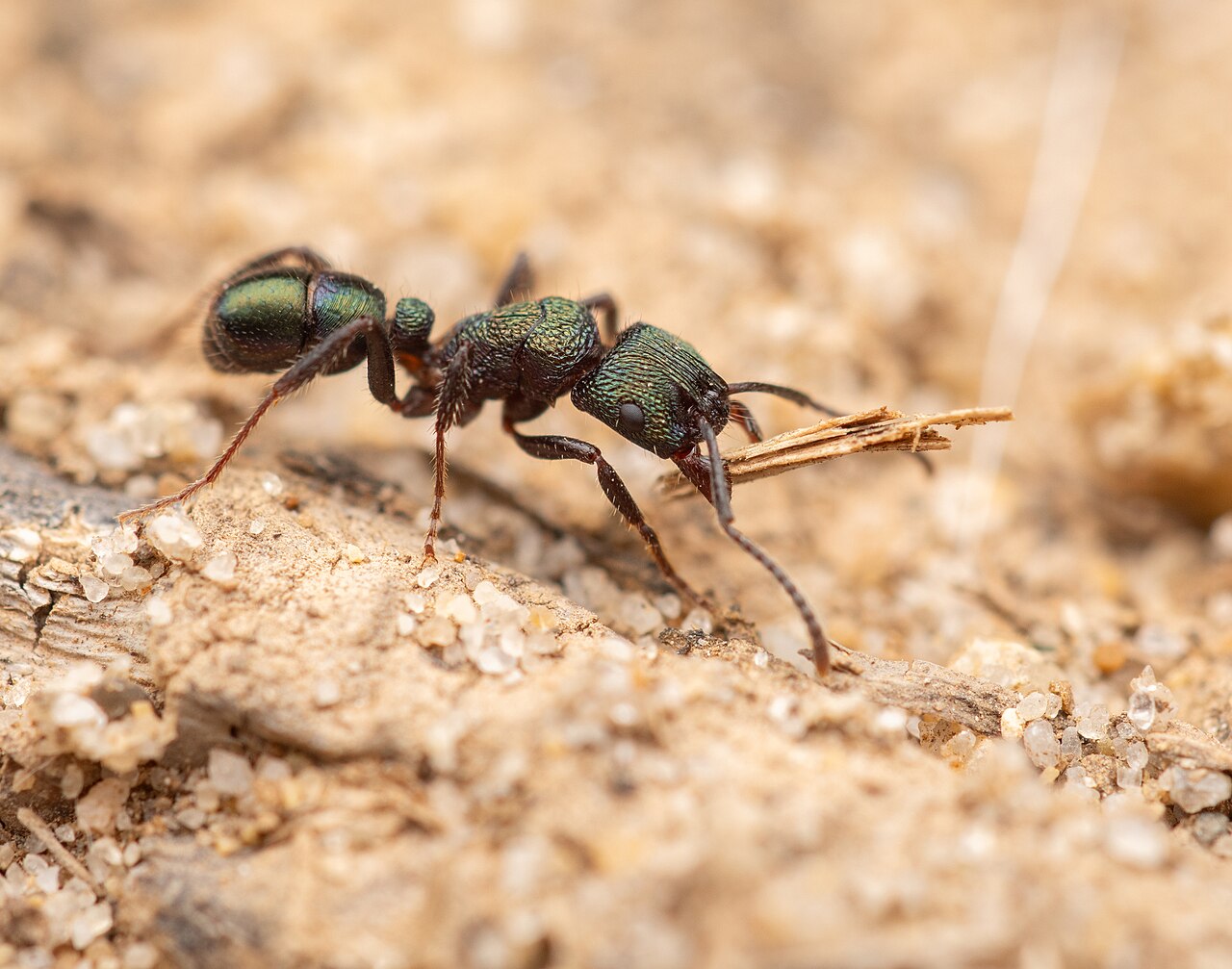
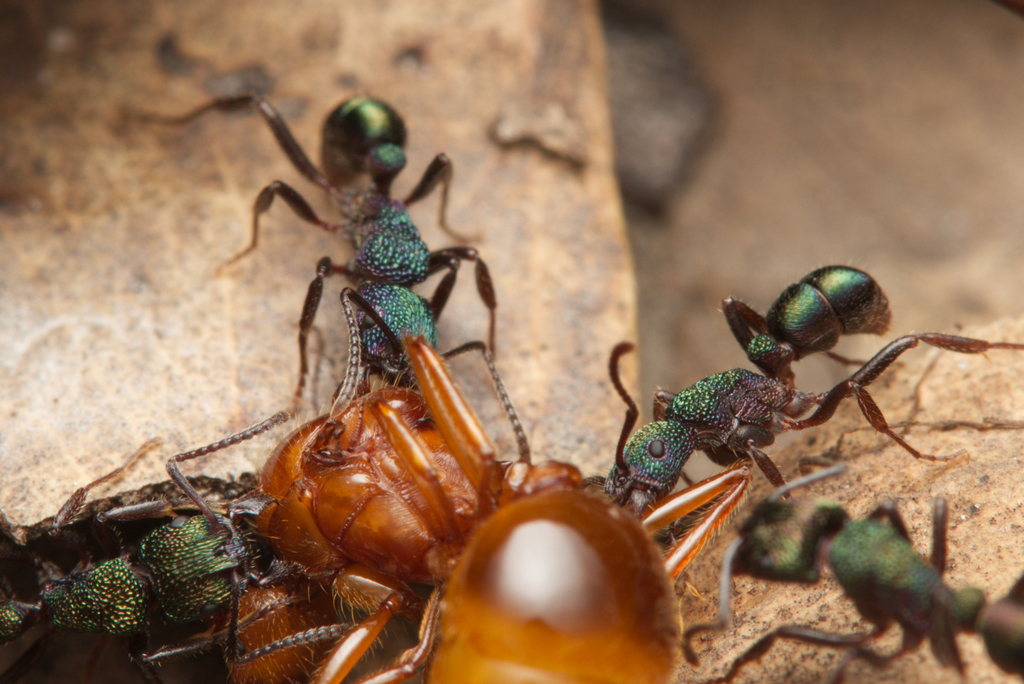
The green-head ant (Rhytidoponera metallica) is one of the most common ants in Australian gardens and bushland, and it is easy to spot by its shiny metallic green-blue head and body. It is an active, daytime ant that is good to watch, but it does not behave like most pet ants and it can sting, so please read the notes below before you buy.
- Species: Rhytidoponera metallica
- Common name: Green-head ant (green-headed ant)
- Difficulty: Intermediate
- Diet: Sugars (honey or sugar water) plus small insects; also takes some seeds
- Size: Workers about 5–7 mm; queens, where present, are only a little larger
- Temperament: Active and diurnal; not very aggressive, but it will sting if disturbed
- Colony growth: Slow to moderate; wild colonies are usually in the low hundreds
- Housing: Test tube, then a small nest with an outworld; the ants find smooth glass and plastic hard to climb
Key points
- Queens and gamergates: In the wild most green-head colonies have no queen at all. Several mated workers, called gamergates, lay the eggs instead. Winged queens do occur but are uncommon (Ward 1986, Psyche). That is why we describe this as a colony led by a queen or by gamergates, and why we cannot promise you will be able to point to a “queen”.
- What that means for you: Because more than one worker can lay eggs, losing a single egg-layer is not necessarily the end of the colony. It also means colonies grow more slowly than most sugar ants, so be patient. Hobby sites that quote colonies of thousands are well above the sizes measured in the research (one excavated field colony had 157 workers).
- Founding: Hobby sellers describe founding as semi-claustral, so a founding female should be offered a little sugar and protein. In a laboratory study, queen-founded colonies also needed to forage (Ward 1986).
- Polymorphism: None to speak of. Workers are all about the same size and there is no large soldier caste.
- Diet: In the wild they hunt and scavenge small insects, take honeydew and carry seeds. In captivity, offer honey or sugar water plus small amounts of protein such as fruit flies or crushed mealworm.
- Habitat: Open forest, woodland, heath and suburban gardens, nesting in shallow soil under stones, logs and shrubs. They are one of the commonest ants around Canberra.
- Temperature: Hobby care sheets suggest roughly 22–28°C in the nest. Activity slows in cool weather, and no special winter rest is needed.
- Humidity: Offer a gradient rather than one setting: a lightly damp end of the nest (hobby sheets suggest about 50–70%) and a drier outworld (about 40–60%), so the ants can choose. Published figures vary between care sheets.
- Feeding: Small amounts, little and often. Give protein once larvae are present, and clear away uneaten insects.
- Escape risk: Low to moderate. Hobby sellers report that workers struggle on smooth glass and plastic, but use a snug lid anyway and do not rely on it.
- Interesting observation: Green-head ants are among the first insects to forage after a bushfire, sometimes as soon as the embers stop smouldering (Australian Museum). Their habit of carrying seeds back to the nest also helps spread native plants.
A note on stings
Green-head ants have a real sting. For most people it is painful but short-lived. A small number of people are allergic to ant venom and can have a severe reaction (anaphylaxis). In an Australian study of people who had suffered anaphylaxis from ant stings, 34 of the 299 whose cause was identified had reacted to green-head ants (Brown et al. 2011, Medical Journal of Australia).
Please do not buy this species if anyone in your home has a known insect-sting or ant-venom allergy. Keep the nest secure, do not handle the ants, and seek urgent medical help (call 000) for any signs of a serious reaction, such as trouble breathing, swelling of the face or throat, or feeling faint.
What you get
A queen-led or gamergate-led colony with a small number of workers and brood: a small colony, typically around 5 workers. Numbers and the amount of brood vary with the season and what we have available.
Shipping and the law
We ship within Australia only. We do not send this species to Western Australia or Tasmania without the relevant clearance. Western Australia prohibits entry of organisms that are not on its permitted list, so we do not send to WA unless Quarantine WA has confirmed in writing that the species is allowed. Tasmania allows only three ants to be imported without restriction (Camponotus consobrinus, Camponotus claripes and Colobopsis macrocephala), so a Tasmanian import permit would be needed for this one. Please check your own state or territory’s rules before you order. Our guide has the details: Is it legal to keep ants in Australia?
Care guides
- Test tube setup for a founding ant queen
- What to feed pet ants in Australia
- Best formicarium for beginners
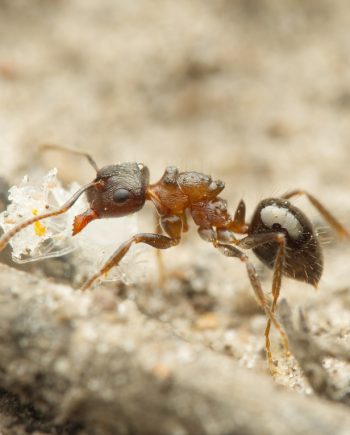
Photo credits: Rhytidoponera metallica by Philipp Hoenle, CC0 1.0, via Wikimedia Commons; Rhytidoponera metallica by Nigel Main, CC BY 4.0, via iNaturalist.

Reviews
There are no reviews yet.